A circle of teachers,
colour by colour,
around the world.
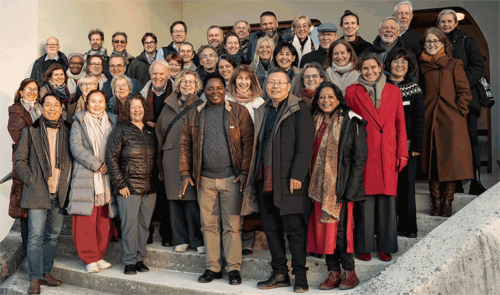
Since 1970 the Hague Circle has gathered active Waldorf teachers from every continent — to safeguard the quality of Waldorf education and to develop it together.
Twice a year, from all over the world.
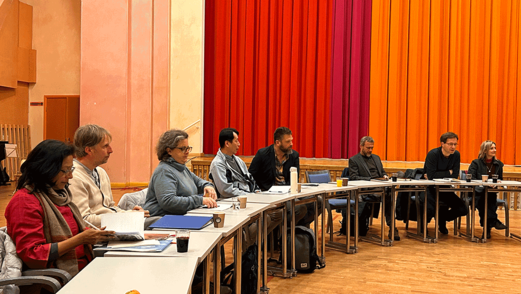
Active Waldorf teachers meet for a multi-day conference in one of the participating countries or at the Goetheanum in Dornach. The conferences serve the mutual understanding and exchange on key educational issues of national or global significance.
Participants are appointed by the institutions responsible for Waldorf education in their home countries and work closely with them.
- 01Supports, promotes and ensures the quality of Waldorf education.
- 02Ensures mutual awareness and cooperation between institutions.
- 03Draws up the essential characteristics and represents the movement worldwide.
- 04Recognises institutions — the prerequisite for the Waldorf licence.
How the Circle is organised
Why a worldwide council is needed — and how the Waldorf World List and the World Teachers’ Conference came about.
Organisation
Waldorf education has spread across the world in recent decades. There are meanwhile more than 1,000 Waldorf schools, several thousand Waldorf kindergartens, and numerous schools working on the basis of Waldorf education and anthroposophical special needs education with children and young people in need of additional help.
The ongoing growth in the spread of Waldorf schools is due in every case to the local initiative of individual people or communities and is not controlled centrally. But this precisely makes it necessary for Waldorf teachers from all over the world to agree on common core concerns and minimum standards in order to be able to protect the specific quality of this system of education and continue to develop it in the awareness of its methods and principles (see: Key Characteristics of Waldorf Education).
In many countries the Waldorf schools and Waldorf kindergartens have joined together to form their own associations which take care of the training of the next generation of teachers, quality development and representing their member schools towards public authorities (see: links).
But the worldwide collaboration between Waldorf educational establishments requires an organ in which the experiences, needs and insights from all regions of the world can flow together and be exchanged. Furthermore, many schools in regions which do not yet have their own associations need support as they develop their schools and kindergartens. Lastly, contacts in authorities and politics need a reference address from which they can obtain reliable information as to whether a school is approved as a Waldorf school. To this end the German Association of Waldorf Schools, which protects the name "Waldorf school" under international trademark law, has approved the following procedure:
The International Council for Steiner Waldorf Education in close collaboration with the "Friends of Waldorf Education", IASWECE – International Association for Steiner/Waldorf Early Childhood Education and the Pedagogical Section at the Goetheanum draws up a constantly updated "Waldorf World List" which lists all Waldorf schools/kindergartens/seminars which have been approved as Waldorf establishments.
Also in collaboration with the Pedagogical Section, the International Council for Steiner Waldorf Education organises the World Teachers’ Conference.